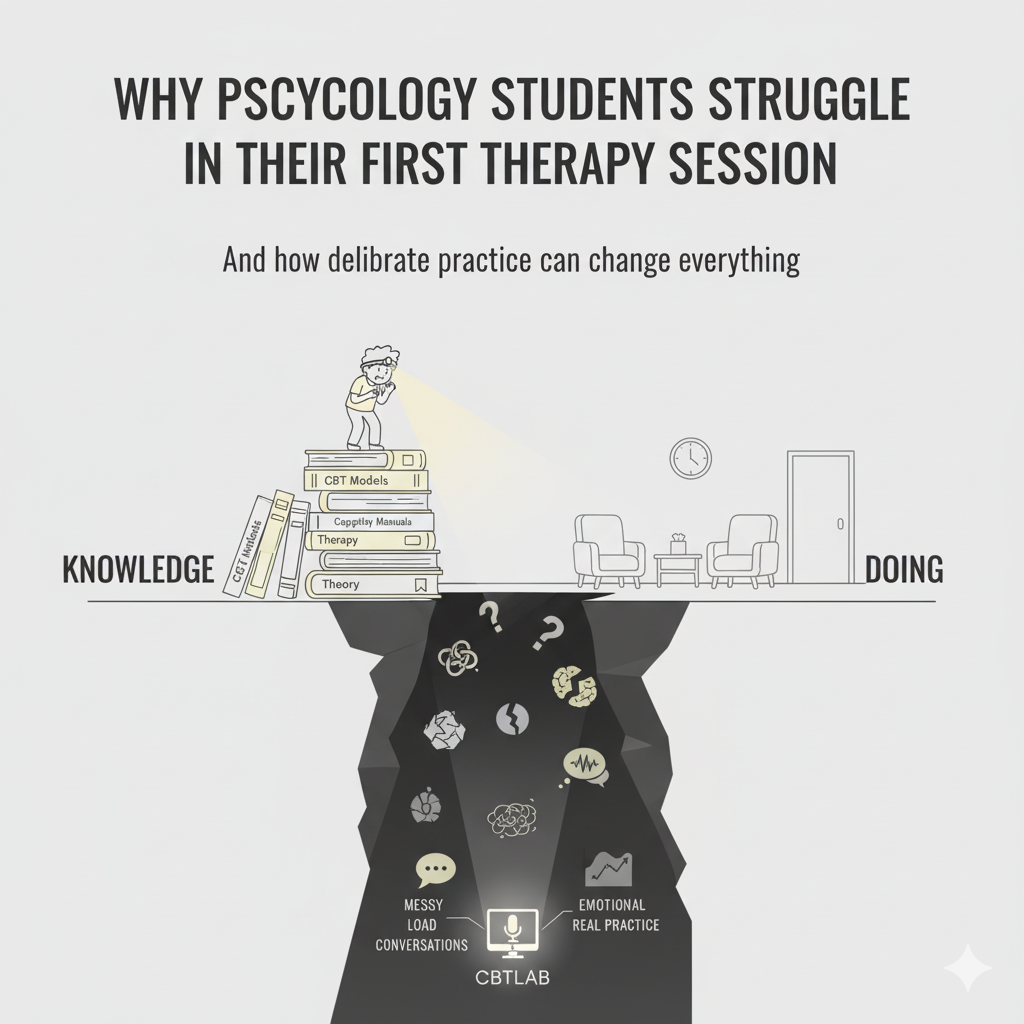
Why Psychology Students Struggle in Their First Therapy Session
And how deliberate practice can change everything
“You can know every model, memorize every bias, score high on exams — and still freeze the moment you sit across from a real client.”
The first therapy session shocks even the most prepared students.
Because the gap between knowing and doing is wider than most training programs admit.
Let’s break down the six most common reasons students struggle — and what actually helps.
1. Expecting the session to go ‘by the book’
Real clients don’t speak in textbook order.
No neat automatic thoughts, no tidy emotions. Just pauses, contradictions, confusion.
Many students panic, thinking they’re doing something wrong.
In fact, this is the work — sitting with uncertainty until meaning takes shape.
Shift:
Stop chasing textbook precision.
Focus instead on the frame: agenda, goals, collaboration, safety.
2. Over-focusing on techniques, under-focusing on relationship
Internal monologue:
“Should I challenge this thought? Which question fits here?”
Meanwhile, the client silently asks:
“Do you understand me? Am I safe here?”
In CBT, the relationship isn’t a bonus — it’s the vehicle for every intervention.
Shift:
Lead with empathy before analysis.
Reflect, pace, and match the client’s emotional rhythm.
3. Fear of ‘doing harm’ → paralysis
Early therapists worry:
“What if I make it worse?”
The fear is valid — but silence helps no one.
Competence grows through active engagement and repair, not avoidance.
Shift:
Aim for “good enough.”
Tiny missteps are repairable; avoidance isn’t.
4. Missing internalized scripts and micro-skills
Experienced therapists run sessions from internal schemas —
open → set agenda → elicit → validate → summarize → plan.
Students don’t have those maps yet; every move requires conscious effort.
The cognitive load is huge — no wonder they freeze.
Shift:
Break the session into trainable micro-skills.
Practice each in isolation until it feels automatic.
5. Misjudging what success means
A first session isn’t about insight or solutions.
It’s about trust, focus, and alliance.
Redefine success:
A good first session is one where the client feels understood, safe, and sees a path forward.
6. Practicing theory, not conversations
Typical “practice”: reading, lectures, exams.
Missing: messy, emotional dialogue; unpredictable clients; feedback on actual words spoken.
Without real interaction, confidence collapses.
This is exactly the training gap CBTLAB was built to close.
What actually helps students improve
- Realistic simulations
- Deliberate practice of micro-skills
- Instant, structured feedback
- Cases that feel human, not idealized
When students train this way:
They stop panicking.
They think clinically.
They feel the rhythm of a real session.
They start doing therapy — not performing it.
Next step
At CBTLAB we’re building the flight simulator for therapy skills — a safe, data-driven environment to practice, get feedback, and grow before meeting real clients.
